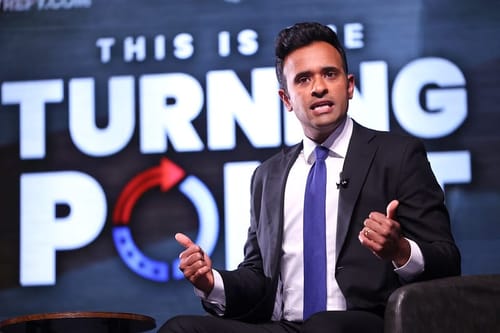

Republican gubernatorial nominee Vivek Ramaswamy has built his pitch to Ohio voters around a single, repeated promise: that he will turn the Ohio River Valley into the next Silicon Valley, powered by an aggressive expansion of artificial intelligence data centers and the energy infrastructure to feed them.
New national polling and on-the-ground organizing across rural Ohio suggest the vision is colliding with the people who would have to live with it.
A Gallup poll released May 13 — the firm’s first ever measuring local opinion on AI data centers — found that 71 percent of Americans oppose building one in their local area, including 48 percent who are strongly opposed. Roughly a quarter favor the idea, and only 7 percent strongly favor it. Opposition to local data centers runs higher than opposition to local nuclear power plants, 71 percent to 53 percent.
Gallup reported that opposition crosses political and demographic lines. Forty-six percent of respondents said they worry “a great deal” about the environmental impact of AI data centers, and another 24 percent worry “a fair amount.” The polling firm noted that politicians who favor data centers in their area “are likely taking a politically risky stance.”
Ramaswamy has spent the past year doing exactly that.
”The next Silicon Valley”
In a Fox News appearance ahead of his February 2025 campaign launch, Ramaswamy framed his vision plainly: “As if Silicon Valley led the way in the American economy for the last ten years, I want to make sure it’s the Ohio River Valley for the next ten years.”
He repeated the line throughout the primary campaign, often paired with calls to “unshackle” Ohio’s energy production, attract more semiconductor and AI infrastructure, and welcome Bitcoin mining operations into the state. After easily defeating nonprofit founder Casey Putsch in the May 5 Republican primary, Ramaswamy now faces Democrat Amy Acton, the former state health director, in November.
The pitch is built around a state that is already among the most aggressive data center hosts in the country. Ohio has roughly 200 data centers — the fifth-most of any state — and companies have announced plans to invest up to $40 billion more by 2030. Since 2017, the industry has collected an estimated $2.5 billion in state and local tax breaks, including sales tax exemptions and property tax abatements of 75 percent that can last 15 to 30 years.
What Ramaswamy has not done is reconcile that pitch with the costs Ohio communities are already paying.
Rising bills, strained water, few permanent jobs
A single hyperscale data center can consume as much electricity as 80,000 to 100,000 homes. At an August 2025 Ohio Chamber forum, Ramaswamy himself acknowledged that Ohio’s electricity costs are roughly 50 percent higher than they were and projected to climb another 50 percent. He attributed the increase in part to data center demand, then argued the answer was to build more data centers and produce more fossil fuel energy to power them.
The Ohio Chamber of Commerce’s own analysis has flagged water as another flashpoint. Under the most likely growth scenario modeled by the Chamber, central Ohio — where most data centers are concentrated — faces 56 instances where water demand outstrips supply by 2040.
The job-creation case has also frayed under scrutiny. While construction crews build new server farms in waves, the permanent workforce at a finished facility is often a fraction of what a comparable industrial site would employ. A University of Virginia analysis found that as of 2024, Ohio’s data centers had generated roughly 22,300 short-term construction jobs but only about 4,500 permanent positions. Policy Matters Ohio found that of the nearly $1.1 billion in private investment Gov. Mike DeWine announced for the state in 2024, more than 90 percent was new Microsoft data center construction — which accounted for less than 5 percent of the new jobs created.
One recent Ohio data center project received a $4.5 million state tax exemption to create 10 permanent jobs.
Rural Ohioans push back
The backlash Ramaswamy is wagering against has organized itself into something more durable than a few town hall complaints.
A group of residents from Adams and Brown counties in southwest Ohio — operating as Ohio Residents for Responsible Development — cleared the Ohio Ballot Board on April 3 and is now gathering signatures for a constitutional amendment that would ban construction of any data center using more than 25 megawatts of power. The all-volunteer effort must collect more than 413,000 valid signatures from at least 44 of Ohio’s 88 counties by July 1 to make the November ballot.
“It’s definitely not one county. It’s definitely not only rural areas, although the push is coming from rural areas,” Austin Baurichter, a lawyer working with the group, told the Statehouse News Bureau. “And I would say, don’t ever count out the people out here. Don’t ever count out the voices of us Ohio residents on making it known what we want to do.”
At least 15 Ohio communities have enacted moratoriums on new data center construction, according to the same reporting. Lawmakers in at least 11 other states have introduced legislation to temporarily ban or restrict data centers.
The Ohio General Assembly has begun trying to catch up. The Ohio House passed a revised version of House Bill 646 on March 18, which would create a 13-member Data Center Study Commission to examine the industry’s effects on water, electric infrastructure, farmland, tax incentives and local government and report back with recommendations within six months.
Ramaswamy has not publicly endorsed a study, a moratorium, or any structural change to the tax incentive regime that has fueled the buildout. His verified social media posts on the subject continue to describe the data center boom as “good” and frame the conversation around producing more energy rather than examining what is consuming it.
A wager against where Ohio is going
Ramaswamy’s own financial position adds another layer to the politics. His Dallas-headquartered asset management firm, Strive, disclosed in a May 19 SEC filing that it now holds 15,391 Bitcoin — making it the ninth-largest public corporate Bitcoin treasury in the country. Bitcoin mining is one of the most electricity-intensive uses of data center infrastructure, and Ramaswamy has explicitly said he wants Bitcoin mining operations in Ohio. His top two super PAC donors, who together have given roughly $24 million to support his campaign, are crypto investors.
The competitive math of the November race also makes the data center issue more than abstract. A BGSU/YouGov poll conducted April 7-14 showed Ramaswamy leading Acton 48 to 47 percent — within the margin of error. A Democrat has not won the Ohio governor’s office since Ted Strickland’s 2006 victory, but the structural advantage Republicans have enjoyed for nearly two decades is not insulated from a backlash that, as Gallup found, crosses party lines.
The Adams and Brown county petitioners have until July 1 to qualify their amendment for the November ballot. If they succeed, Ohio voters could end up casting two related votes the same day — one on whether to allow the kind of large-scale data center expansion Ramaswamy is selling, and one on whether to hand him the office that would help deliver it.
Ohio’s general election for governor is November 3, 2026.