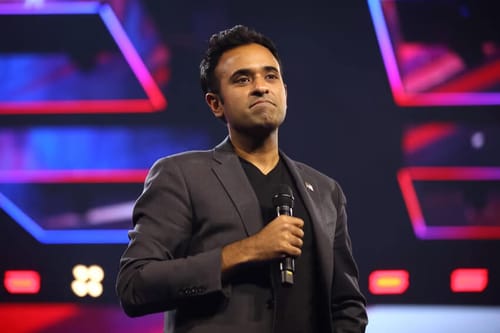
Vivek Ramaswamy wants Ohio to welcome more AI data centers and Bitcoin mining operations. He has said so repeatedly — in speeches, in social media posts, and at campaign events across the state.
What he hasn’t said is that his own company is heavily invested in the cryptocurrency those mining operations produce, that his two largest super PAC donors are crypto billionaires, or that data centers have collected $2.5 billion in Ohio tax breaks since 2017 while creating relatively few permanent jobs.
Ramaswamy, the GOP-endorsed frontrunner in the 2026 governor’s race, has made data centers a central part of his economic pitch. At a March 2025 speech at the Jefferson County Republican Party Lincoln Day Dinner in Wintersville, he laid it out directly: “It takes two years to build an AI data center or Bitcoin mining firm or whatever — all of which I want in the state, by the way.”
He has called the data center boom “good” on his verified X account at least three times since March 2025, consistently framing it as an economic opportunity while blaming rising electricity costs on insufficient fossil fuel production rather than the facilities themselves.
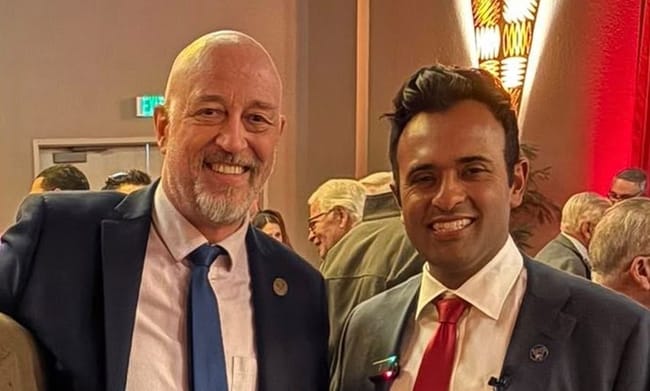
“We’re seeing an AI data center boom (which is good), right at the time when we face supply constraints on baseload power generation,” Ramaswamy posted on March 27, 2025. “I’ll unshackle energy production in Ohio, from fossil fuels to nuclear energy, without apology.”
His answer to the strain data centers place on Ohio’s power grid is not to regulate the facilities or slow their expansion. It is to deregulate energy production and build more fossil fuel infrastructure to keep up with them.
The crypto connection
Ramaswamy’s enthusiasm for data centers and Bitcoin mining doesn’t exist in a vacuum. He has deep personal financial ties to the cryptocurrency industry.
His asset management company, Strive, pivoted aggressively into Bitcoin after Donald Trump signaled that his administration would make the U.S. a global crypto hub. As of late March 2026, Strive held 13,628 Bitcoin purchased at an average price of $105,850 per coin, according to a joint investigation by The American Prospect and the Center for Media and Democracy. With Bitcoin fluctuating around $66,900, the value of those holdings has declined more than 37 percent.
Ramaswamy owned approximately 114 million shares — about 10 percent — of Strive’s outstanding common stock as of January 22, 2026. Strive’s stock price is now directly tied to Bitcoin’s value.
Bitcoin mining is one of the most energy-intensive commercial activities in the world. It requires precisely the kind of large-scale data center infrastructure Ramaswamy wants to bring to Ohio. More data centers running more mining operations means more demand for Bitcoin infrastructure — which is good for Strive.
Follow the donor money
The two largest donors to Ramaswamy’s gubernatorial super PAC in 2025 are deeply invested in cryptocurrency.
Ross Stevens, who donated $14 million, is actively involved in Bitcoin and crypto ventures. Jeff Yass, who donated $10 million, holds more than $2 billion in Strategy (a firm that exclusively invests in Bitcoin) and more than $2 billion in Coinbase (a crypto exchange) through his company Susquehanna International Group.
That’s $24 million from two donors with direct financial stakes in the expansion of crypto infrastructure — the same infrastructure Ramaswamy is promising to bring to Ohio.
In January 2025, while still serving as co-lead of Trump’s Department of Government Efficiency, Ramaswamy publicly praised Ohio House Bill 18, which would allow the state treasurer to invest up to 10 percent of the state’s general fund and budget stabilization fund into a Bitcoin reserve. He called it “a thoughtful & powerful bill.”
As governor, Ramaswamy would have the power to appoint trustees of state pension funds overseeing roughly $250 billion in assets, including the Ohio Public Employees Retirement System and the Ohio State Teachers Retirement System.
What data centers actually deliver
While Ramaswamy frames data centers as engines of prosperity, the numbers tell a different story for the communities that host them.
Ohio has approximately 200 data centers — the fifth-most of any state — and companies plan to invest up to $40 billion more by 2030. But the Ohio Consumers’ Counsel notes that “while construction creates short-term jobs, data centers create relatively few permanent jobs once they are built.”
How few? As of 2024, Ohio’s data centers had created roughly 22,300 short-term construction jobs but only about 4,500 permanent positions, according to a University of Virginia report. In 2024, Governor DeWine announced nearly $1.1 billion in private investment coming to Ohio — 90.9 percent of which was new Microsoft data center facilities that accounted for just 4.8 percent of the new jobs created.
One recent Ohio data center project received a $4.5 million state tax exemption to create 10 jobs.
Meanwhile, the industry has received $2.5 billion in state and local tax incentives since 2017, including sales tax exemptions, job creation tax credits, and local property tax abatements of 75 percent lasting 15 to 30 years.
Rising bills, strained water, lost farmland
For rural Ohioans, the costs are more immediate than abstract economic projections.
A single large “hyperscale” data center can consume as much electricity as 100,000 homes. Ohio electric bills have spiked dramatically in recent years, a trend industry analysts attribute in significant part to data center demand. At an August 2025 Ohio Chamber forum, Ramaswamy himself acknowledged that electricity costs are roughly 50 percent higher and projected to jump another 50 percent.
He attributed the problem in part to data center demand — then proposed building more data centers anyway.
Water is another flashpoint. The Ohio Chamber of Commerce’s own report acknowledged serious threats to water supplies, particularly in central Ohio, where the majority of data centers are clustered. Under the most likely growth scenario, the region faces 56 instances where water demand outstrips supply by 2040.
Rural communities have also raised alarms about the loss of farmland to massive server warehouses, noise pollution, and local officials signing nondisclosure agreements with data center developers that prevent residents from getting basic information about projects proposed for their communities.
Rural Ohioans are pushing back
The backlash has reached the ballot. A group of rural southwest Ohio residents — organized as Ohio Residents for Responsible Development — cleared the Ohio Ballot Board on April 3 and is now gathering signatures for a constitutional amendment that would ban the construction of data centers using more than 25 megawatts of power.
The all-volunteer effort, led by residents of Adams and Brown counties, must collect more than 413,000 valid signatures from at least 44 of Ohio’s 88 counties by July 1 to make the November ballot.
“It’s time to conserve Ohio and not let data centers take away all the natural resources that we are plentiful of so we have life for generations to come,” Adams County resident Nikki Gerber told the Ohio Capital Journal.
At least 15 Ohio communities have enacted moratoriums on new data center construction. Lawmakers in at least 11 other states have introduced legislation to temporarily ban or restrict data centers.
What Ramaswamy won’t talk about
In none of his verified public statements does Ramaswamy address the tax incentive structure that lets data centers operate on deeply discounted property tax bills for decades. He does not address water consumption. He does not address land use or farmland loss. He does not address the nondisclosure agreements that shut rural residents out of planning decisions.
His one consumer-facing talking point — that he’ll make “AI hyperscalers pay for their own energy usage” — mirrors the Trump administration’s Ratepayer Protection Pledge, a voluntary agreement with no enforcement mechanism. It does nothing about the $2.5 billion in tax breaks, the water depletion, the loss of agricultural land, or the reality that a billion-dollar data center campus might employ fewer people than a single Walmart.
Ramaswamy’s vision for Ohio is an economy built around the industries that enrich him and his donors. He frames it as prosperity. Rural Ohioans living with the consequences are framing it as something else entirely.