
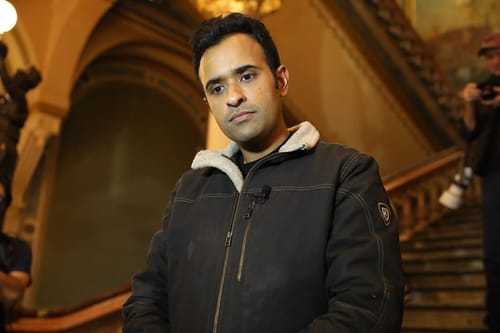
Republican gubernatorial frontrunner Vivek Ramaswamy stands to personally benefit from the same cryptocurrency policies he is promoting for Ohio, according to his newly filed financial disclosure with the Ohio Ethics Commission.
Ramaswamy’s disclosure, filed on April 6, shows that the billionaire entrepreneur personally holds Bitcoin and Ethereum and retains a roughly 10% ownership stake in Strive, Inc. — a company he co-founded that has committed nearly all of its corporate treasury to Bitcoin.
As of April 2, Strive held 13,741 Bitcoin purchased at an average cost of roughly $105,850 per coin, according to SEC filings and an investigation by The American Prospect and the Center for Media and Democracy. With Bitcoin trading at approximately $71,000 on Monday — a decline of roughly 33% from Strive’s average purchase price — the company’s cryptocurrency holdings have lost hundreds of millions of dollars in value.
Every dollar Bitcoin’s price rises is a dollar closer to recovering those losses — for both Strive and its co-founder.
The policy connection
Ramaswamy has made cryptocurrency a centerpiece of his economic pitch to Ohio voters. In January 2025 — while still serving as co-lead of President Trump’s Department of Government Efficiency — he publicly praised Ohio House Bill 18, the Ohio Strategic Cryptocurrency Reserve Act, calling it “a thoughtful & powerful bill” in a post on X.
HB 18, introduced by Rep. Steve Demetriou (R-Chagrin Falls), would authorize the State Treasurer to invest up to 10% of state interim funds — including the general revenue fund and budget stabilization fund — in digital assets. It would also permit Ohio’s five public pension systems, which cover hundreds of thousands of teachers, police officers, firefighters, and public employees, to invest in crypto-linked exchange-traded products.
Those five pension systems hold a combined $257 billion in assets, according to the Ohio Retirement Study Council. Under HB 18’s 10% cap, tens of billions of dollars in Ohio public money could flow into Bitcoin and similar digital assets — institutional buying pressure that could drive up the price of the cryptocurrency Ramaswamy and Strive already hold.
The bill has received five hearings in the House Technology and Innovation Committee but has not advanced to a floor vote.
Governor’s power over pensions
As governor, Ramaswamy would have the authority to appoint trustees to Ohio’s state pension boards — the same boards that would make decisions about whether to invest in cryptocurrency under HB 18.
Chris Tobe, a financial analyst and former pension trustee in Kentucky, told the Center for Media and Democracy that the governor has “great influence” over state funds in Ohio. Tobe warned that Ramaswamy’s connections to crypto through Strive could create conflicts at the intersection of public pension oversight and personal financial interest.
Not all Ohio Republicans share Ramaswamy’s enthusiasm. House Speaker Matt Huffman (R-Lima) told reporters last fall that he thinks the legislature needs “a long, hard look” at crypto investments, adding that he is “still scratching my head over cryptocurrency.”
Strive’s Bitcoin losses
Strive, Inc. (Nasdaq: ASST) began as an anti-ESG asset management firm Ramaswamy co-founded in 2022. After Trump signaled support for making the U.S. a global crypto leader, the company pivoted to Bitcoin, raising $750 million and merging with Asset Entities in September 2025 to become what it called “the first publicly traded asset management Bitcoin Treasury Corporation.”
That bet has not paid off. Strive’s stock price has fallen approximately 96% since its initial public offering, and the company reported a $393 million net loss in its first six months as a public Bitcoin treasury company, driven largely by unrealized losses on its cryptocurrency holdings.
Michael McGovern, CEO of Innovation Ohio, a progressive policy organization, said the financial disclosure makes the conflict clear.
“Why else would he be pushing for risky public investment in crypto?” McGovern said. “That’s not a policy agenda for working Ohioans. It’s a bailout for Vivek.”
Campaign donors with crypto ties
Ramaswamy’s largest campaign donors also have significant stakes in the cryptocurrency industry. The top donor to his gubernatorial super PAC in 2025 was Ross Stevens, who gave $14 million and is actively involved in Bitcoin and crypto. The second-largest donor was Jeff Yass, who gave $10 million. Yass’s firm, Susquehanna International Group, holds more than $2 billion in Strategy (formerly MicroStrategy), a company that exclusively invests in Bitcoin, and over $2 billion in Coinbase, a crypto exchange, according to the American Prospect investigation.
Those two donors alone account for $24 million in super PAC contributions from individuals with direct financial interests in the expansion of cryptocurrency markets and infrastructure — the same policies Ramaswamy has pledged to advance as governor.
Ramaswamy’s campaign has not publicly addressed the overlap between his personal financial holdings, his donors’ interests, and the crypto-friendly policies he has endorsed.
The financial disclosures filed with the Ohio Ethics Commission are available for download through Signal Ohio’s coverage.