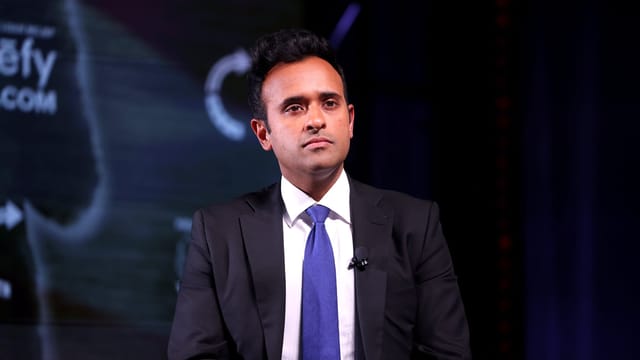

Republican gubernatorial candidate Vivek Ramaswamy backed a proposed national COVID-19 registry that would have separated Americans by immunity status, and a biotech firm he founded later secured a $2.25 billion settlement tied to COVID-19 vaccines, according to Associated Press reporting published Saturday, a March 3 corporate announcement, and previously published reporting in his own words.
The reporting lands three days before Tuesday’s Republican primary, in which Ramaswamy is the front-runner.
A national registry to ‘segregate’ Americans
One of Ramaswamy’s companies — the healthcare data firm Datavant — pushed for a national COVID-19 registry that would have allowed the small share of Americans gaining natural immunity to “get back to normal life,” while the rest of the population would continue to be “segregated,” the AP reported Saturday. The quoted language comes from the proposal itself.
The concept did not originate with Datavant alone. In April 2020, Ramaswamy told the host of a Rockefeller Capital Management podcast that he had been discussing the idea with policymakers, including a U.S. senator, according to reporting by Contra that transcribed the interview.
“Could we tolerate a national system in which certain people on the basis of a biomarker are segregated?” Ramaswamy asked on the podcast, according to Contra. He answered his own question: “I personally think that it is better than the status quo if we can send 10 or 20 percent of the people back on the basis of having immunity.”
A discussion draft obtained by Contra showed Ramaswamy proposing a “public-private partnership” featuring an entity he called “Organization X” — described as “a division of government, a private company, or a nonprofit organization” — that would maintain “the registry of individuals who are immune and individuals who should be prioritized for testing.”
Five days after the Rockefeller podcast appearance, The Wall Street Journal reported that Datavant was “spearheading” an effort to create a national COVID-19 patient registry by pooling medical records. By November 2020, Datavant had entered into a partnership with the National COVID Cohort Collaborative — a program funded by the National Institutes of Health, according to the company’s own press release at the time.
In an interview with the AP this week, Ramaswamy said his support for the registry was about getting the economy moving again. He described his overall position on the virus as nuanced.
$2.25 billion from COVID-19 vaccines
On March 3, Roivant Sciences — the biotech firm Ramaswamy founded in 2014 and led as CEO until 2021 — announced that subsidiary Genevant Sciences and partner Arbutus Biopharma had reached a $2.25 billion global settlement with Moderna over the pharmaceutical company’s unauthorized use of their lipid nanoparticle delivery technology in its COVID-19 vaccines, including Spikevax.
Under the terms of the settlement, Moderna will pay Genevant and Arbutus $950 million upfront in July, with an additional $1.3 billion contingent on a future appellate court ruling, according to the announcement.
Datavant was incubated under Roivant in 2017. Ramaswamy stepped down from the Roivant board in early 2023, before launching his 2024 presidential campaign. According to the AP, his gubernatorial campaign referred questions about his time at Roivant to the company, which did not respond.
Attacking Acton on the same issue he profited from
Ramaswamy has built much of his Republican primary campaign around attacking Democratic gubernatorial candidate Dr. Amy Acton over the public health orders she signed as Ohio’s health director in 2020. The AP reports that Ramaswamy has accused Acton at his rallies of spreading dangerous COVID ideology.
Acton’s campaign spokesperson, Addie Bullock, told the AP that Acton is proud of the work she did with Gov. Mike DeWine to put public health over politics and save lives, and called Ramaswamy’s framing an attempt to play politics with the issue.
A private-sector adviser to Ohio’s pandemic response
While running Roivant during 2020, Ramaswamy advised Ohio’s then-lieutenant governor on the state’s COVID-19 response, according to a 2021 op-ed Ramaswamy himself wrote for Cleveland.com that the AP cites in its reporting. The lieutenant governor at the time was Jon Husted, who was appointed to the U.S. Senate by DeWine in January 2025 and is now running in Tuesday’s Republican primary special election to keep the seat.
Husted was a regular participant alongside DeWine and Acton at Ohio’s daily pandemic briefings throughout 2020.
Ramaswamy told the AP his discussions with Husted, like his support for the COVID registry, were about restarting the economy.
A pattern of pandemic deflection
The AP also reported Saturday that in early 2023, Ramaswamy paid an editor to remove a reference to his service on Ohio’s “COVID-19 Response Team” from his Wikipedia page. He told the AP the edit was a simple correction, saying the panel never met.
TiffinOhio.net previously reported on the same February 9, 2023 Wikipedia edit, which also removed references to Ramaswamy’s Paul & Daisy Soros Fellowship. According to Mediaite’s review of the edit history, the COVID-related content was removed at Ramaswamy’s explicit request.
DeWine endorses Ramaswamy but rejects the Acton attack
DeWine has endorsed Ramaswamy in the Republican gubernatorial primary, but he has publicly rejected one of the campaign’s central attack lines against Acton — the ad faulting her for the order suspending in-person voting in Ohio’s March 2020 primary. The governor told the AP that he, not Acton, made the call to issue that order.
Ohio’s primary is Tuesday, May 5. Polls open at 6:30 a.m. and close at 7:30 p.m.