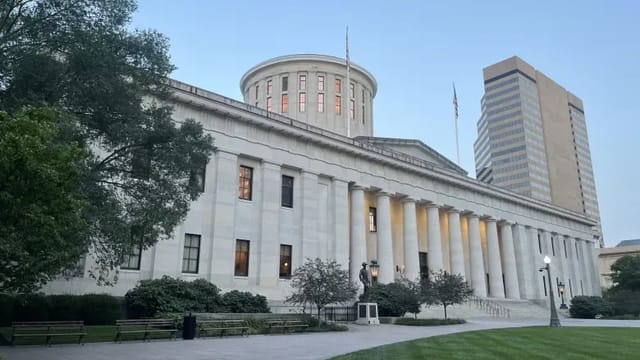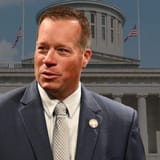
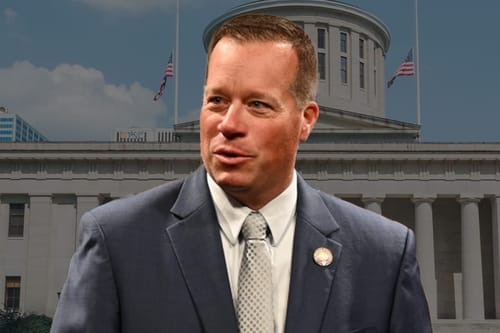
The Ohio House voted 63-30 Wednesday to pass a bill that would ban drag performances and criminalize gender nonconformity in public venues where minors may be present. Among the 44 Republican cosponsors of the bill: state Rep. Rodney Creech (R-West Alexandria), who was accused of climbing into bed with a minor female relative while wearing only his underwear and having an erection, according to Bureau of Criminal Investigation documents.
House Bill 249, titled the “Indecent Exposure Modernization Act,” was framed by its supporters as a child protection measure. Its sponsors said publicly that the bill would also be used to target transgender Ohioans.
Creech was accused in 2023 by a minor female relative of climbing into bed and under the covers with her while erect and wearing only his underwear, according to BCI documents obtained by the Statehouse News Bureau. Text messages showed the minor complaining that Creech had been rubbing her legs and grabbing her waist, according to NBC4. Creech admitted to investigators he had gotten into bed with the minor in his underwear but denied the sexual nature of the allegations.
Clark County Prosecutor Daniel Driscoll, brought in as a special prosecutor, declined to file charges but wrote that Creech’s “behavior during the time of the investigation was concerning and suspicious,” according to documents reported by the Dayton Daily News. Creech has called the allegations “demonstrably false.”
Speaker Matt Huffman stripped Creech of all four committee assignments in May 2025 and asked him to resign. Creech refused. In February, Huffman reversed course, restoring Creech’s committee assignments and signing a letter requesting the Ohio Republican Party endorse Creech for re-election. The party obliged.
Creech’s cosponsorship was raised publicly during committee testimony on March 18. Danielle Firsich, the Director of Public Policy for Planned Parenthood Advocates of Ohio, directly challenged the premise that the bill was about protecting children while Creech remained a cosponsor.
“I also don’t want to be lectured about when it comes to what is obscene or not to children,” Firsich said, according to video reported by Heartland Signal. “You have a man who was just put back on his committees, who was accused of sexual misconduct with a minor, who is a sponsor on this bill. You all let him have his committee privileges back.”
What the bill does
HB 249 expands the definition of “adult cabaret performance” to include “performers or entertainers who exhibit a gender identity that is different from the performer’s or entertainer’s biological sex using clothing, makeup, prosthetic or imitation genitals or breasts, or other physical markers.”
LGBTQ+ organizations, the ACLU, and drag performers who testified against the bill say the language would effectively ban drag performances, Pride parades, and other expressions of gender nonconformity from any venue where a child might be present.
A separate provision substitutes the phrase “private part” for “private area” in Ohio’s public indecency statute — a change that advocates say would criminalize transgender and gender-nonconforming people who use gendered public facilities during daily life.
Public performances that meet the definition of obscenity are already banned under Ohio law.
Penalties under HB 249 range from a first-degree misdemeanor to a fourth-degree felony, depending on the offense.
Sponsors said the bill targets transgender Ohioans
Primary sponsor Rep. Josh Williams (R-Oregon) told lawmakers the bill would stop transgender Ohioans from using gendered public facilities like locker rooms to change their clothing — a use case that has nothing to do with drag performance. Williams repeatedly cited a 2022 incident at a YMCA in Xenia in which a transgender woman was sued after attempting to change in a communal locker room. A judge found the transgender person not guilty of public indecency.
Williams and David Mahan, the policy executive director for the Center for Christian Virtue, said the bill would prevent judges from ruling that way in the future.
Before the full House vote, Williams appeared to call transgender people who use public facilities “perverts.”
“As long as I’m alive, I’m going to prevent perverts from exposing kids to obscene material,” Williams said.
Rep. Jamie Callender (R-Concord) was the only Republican to vote against the bill.
Democrats offered an amendment to strip the language targeting people whose appearance does not match their sex assigned at birth. Rep. Beryl Brown Piccolantonio (D-Columbus) told lawmakers the amendment would “[clarify] that the bill is not meant to target anyone with an appearance that does not match their sex assigned at birth.” Republican members of the House Judiciary Committee voted it down.
Williams opposed the amendment. “This amendment subverts the intentions of the bill’s sponsors,” he said. “It undermines the specific obscene and child endangerment acts we are trying to legislate out.”
In 2023, Arkansas lawmakers gutted similar language from a comparable bill, removing provisions that targeted performers who exhibit gender identities different from their sex assigned at birth.
Who else is behind this bill
HB 249 was sponsored by Reps. Angie King (R-Celina) and Williams, with 44 Republican cosponsors.
King was photographed in 2023 protesting an LGBTQ+ Pride event in her district alongside members of the Aryan Freedom Network, a neo-Nazi group, according to the Buckeye Flame. King said the Small Town Pride festival in Celina motivated her to introduce the drag ban.
Also among the bill’s cosponsors: Rep. Gary Click (R-Vickery), who has sponsored multiple bills targeting LGBTQ+ Ohioans during his time in the legislature.
“This is about shielding the next generation from premature sexualization, from the erosion of their innocence,” King said ahead of Wednesday’s vote.
LGBTQ+ leaders and lawmakers condemn the bill
Equality Ohio Executive Director Dwayne Steward condemned HB 249 in a written statement.
“This bill takes regular, everyday activities and turns them into potential crimes, based on whether somebody else might be offended by what other people are wearing,” Steward said. “This bill gives government the unacceptable power to police what people wear.”
“Drag is just the beginning,” Steward added. “Attacks against drag performers and transgender people, like so many bills that restrict LGBTQ+ visibility, have multiple consequences that endanger fundamental freedoms and safety.”
Rep. Dontavious L. Jarrells (D-Columbus) spoke against the bill on the House floor.
“This bill is not about children,” Jarrells said. “This is about the dehumanization of people who do not look like me.”
“This bill literally singles out people who are trans, those who are gender non-conforming, and basically calls into question, ‘Should you exist in the public eye?’” he added. “When you talk about what this bill really is, it is an attack on human lives.”
Danny Thomas, a Dayton-based drag performer known as Cherry Poppins and a member of the Rubi Girls — a group that raises money for charities supporting the LGBTQ+ community — said the bill would cause drag shows at Pride celebrations, brunches, and other events outside nightclubs to decline.
“There are millions of things we can do to help children, and banning drag isn’t one of them,” Thomas said.
What happens next
HB 249 now moves to the Ohio Senate for consideration. The bill’s passage comes as at least 14 states have pursued similar bans on public drag and gender performance since 2023, according to the Buckeye Flame. In Tennessee, where a similar law was passed, those restrictions are currently unenforceable due to a federal court order.