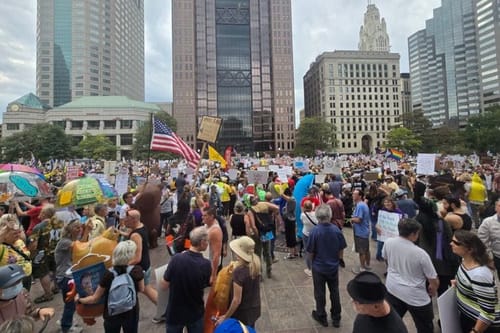

All over Ohio on Saturday, crowds turned out to protest the many controversies of the administration of President Donald Trump.
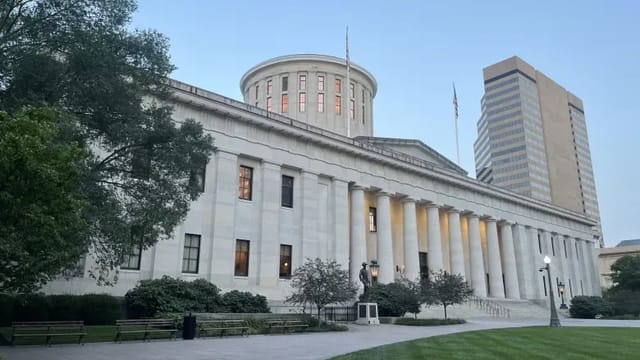
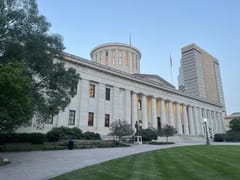
In the midst of a government shutdown over health care subsidies, organizers estimated that more than 10,000 turned out to protest at the Statehouse in Columbus. It was by far the largest protest there against the second Trump administration.
Large demonstrations in Cleveland and Cincinnati were also reported, in addition to estimates of more than 1,000 in smaller communities such as Bexley, Grandview and Pickerington. Indivisible Central Ohio, one of the organizers, estimated that 6,500 turned out in Westerville, more than 4,000 in Clintonville, and 2,000 in Delaware.
National organizers said the Ohio demonstrations were among 2,700 overwhelmingly peaceful protests in 50 states that drew about 7 million people.
“Today, millions of Americans stood together to reject authoritarianism and remind the world that our democracy belongs to the people, not to one man’s ambition,” Ezra Levin and Leah Greenberg, co-founders of Indivisible, said in a written statement. “Authoritarians want us to believe resistance is futile, but every person who turned out today proved the opposite. This movement isn’t about a single protest; it’s about a growing chorus of Americans who refuse to be ruled. Trump may want a crown, but in this country, there are no kings.”
“No Kings” has been a slogan for a protest movement underpinned by dozens of organizers, including 50501, Indivisible, the American Civil Liberties Union and the League of Women Voters. Among many other issues, Trump’s critics object to masked immigration agents conducting violent arrests, attempts to deploy troops to cities over their mayors’ and governors’ wishes, using the Justice Department to target Trump’s political enemies, and bombing boats in the Caribbean on claims they were carrying drugs, but without furnishing any evidence.
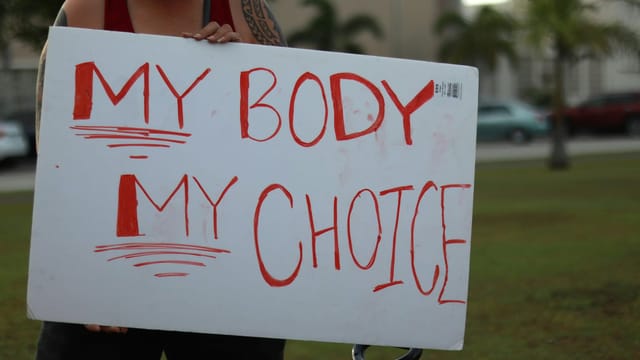
In Columbus, thousands found those and other problems with Trump compelling enough to turn out in the middle of an Ohio State Buckeyes football game. Some noted the fact on signs they were carrying.
Hundreds lined the sidewalks along High Street where it borders the state Capitol. Protesters waved signs, a makeshift band played, people danced and cars streamed by, laying on their horns in support. Ever the football-obsessed community, one car bore a sign saying “This Buckeye supports (Michigan) more than Trump.”
Standing on the Statehouse side of High Street, Columbus resident Phillip Johnson said the stakes couldn’t be higher.
“We’re in trouble as a nation,” he said. “Not since the Civil War has it been this bad. I believe that this is white supremacy’s last stand and Trump is their person out front.”
As a Black man, Johnson said it was inspiring to see thousands come out, many carrying signs decrying what they see as Trump’s and his allies’ racism.
“This right here lets me know that we’re not alone, that people get what’s going on,” he said, adding that it was also a personal call to action.
“There aren’t enough African Americans down here. That lets me know that I have work to do in our community. That’s something I’m getting out of this.”
Stephanie Howard of Columbus said she was protesting “the fascist tactics and illegal actions of this administration around immigration, around free speech, around detaining American citizens and other people.”
She said Trump and his allies have reason to be concerned about the huge turnout for Saturday’s protests.
“They should be worried because this shows them that there are people eager to do something in a peaceful, constructive way,” Howard said. “The people are here and we are ready to push back. We don’t want to fight. We don’t want anyone to get hurt. But people are upset and angry and they are not going to put up with the administration and what it’s doing.”
Republicans, such as House Speaker Mike Johnson of Louisiana, called the protests “Hate America Rallies.” But organizers said the exact opposite was true.
“I heard someone was trying to say we’re unAmerican,” Mia Lewis, assistant director of Common Cause Ohio and a volunteer with Indivisible Central Ohio, said in a written statement. “Honestly, I can’t think of anything more powerfully American than a diverse group of free people exercising their rights, speaking truth to power, and refusing to bow down to a wannabe king!”
Statewide action
Organizers in Central Ohio planned protests for earlier on Saturday in surrounding communities and then a 4 p.m. protest at the Statehouse in Columbus. In Newark, 35 miles east of Columbus, it appeared that more than 1,000 came out at noon to the Licking County Courthouse to show their distaste for Trump.
They played music, chanted and almost made a ring around the courthouse as they marched around the sidewalk.
A few cars sporting Trump flags drove around. In one, a passenger with a bullhorn taunted the crowd, saying they were being paid and had been bussed in. That provoked laughs.
When he said, “ICE is doing its job,” a protester shot back, “Yeah. Fascism.”
Steve Sunkle has spent his life in Newark. Asked if the size of the crowd surprised him, he said, “In this town, yes. You can’t even find a Democratic headquarters here.” (There is one, on Cherry Vally Road.)
But, Sunkle said, sentiment seemed to be shifting.
“I think some of the elderly who voted for him are turning against him,” he said. “I live in an apartment building with 100 apartments. It’s hard to find a fan in that building right now.”
He said inflation and threats to health care are reasons, “and people don’t like to see bombs being dropped on boats in the Caribbean without any proof. That’s not America. That’s the beginning of a totalitarian state.”
Diana Dudgeon stood with a sign that said “I need to be able to tell my grandchildren I did not stay silent.”
She has five grandchildren and has serious worries about the future.
“I’ve been thinking along these lines for awhile, because I’m 79 years old,” she said. “I won’t be around to see all the damage that’s being done. But my grandchildren, my great-grandchildren, will. I just want them to know that I cared enough to try to do something.”
Attending her first protest, Dudgeon said she was surprised that she found it to be such a positive experience.
“This is awesome,” she said. “This is my first time. I feel very empowered. It’s so much more than I expected.”
At the Statehouse later that day, Phillip Johnson said that was the point.
“They say fear is contagious, but so is courage,” he said. “People get a shot in the arm when they see this all over the world.”
This story is republished from the Ohio Capital Journal. View the original article.