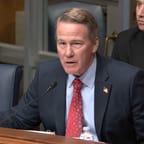
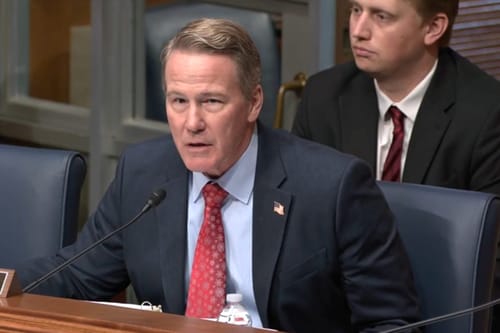

A Columbus attorney is asking the U.S. Senate Select Committee on Ethics to investigate Sen. Jon Husted and his senior adviser, Sean Dunn, after a federal financial disclosure showed Dunn collected $22,652 in consulting fees from the Ohio lobbying firm he founded while working in the senator’s office.
Husted’s office says Dunn has been working with the committee on his reporting obligations. “Our office holds our team to the highest ethical standards. In this case, Mr. Dunn has been in regular contact with the Ethics Committee to ensure he has reported everything to their satisfaction,” spokesperson Olivia Tripodi said in a statement to NOTUS, which first reported the arrangement Thursday. The statement described Dunn’s Senate role as a capstone to his career in public service.
The disclosure at the center of the complaint is Dunn’s personal financial report covering calendar year 2025, filed with Congress on May 14. It lists $22,652 in self-employment income from Statehouse Impact Group LLC, a lobbying and government-affairs firm headquartered in Columbus, paid while Dunn served as Husted’s senior adviser and counsel.
A firm that carried his name for 2 decades
Dunn’s ties to the firm run deeper than a consulting contract. According to the 5-page complaint filed Friday, May 29, by attorney Anne Griffin of Columbus, the company was incorporated with the Ohio Secretary of State as Sean P. Dunn LLC in June 2002 and operated for years as Sean P. Dunn & Associates, with Dunn as its founder and president. It adopted the Statehouse Impact Group name on Feb. 28, 2025 — days before Dunn began his Senate employment on March 3, 2025, according to the complaint. The firm’s own website still describes one of its vice presidents as a longtime leader at “Statehouse Impact Group (formerly Sean P. Dunn and Associates).”
The complaint states that Dunn was registered to lobby in Ohio as recently as Feb. 26, 2025, and that the firm’s clients include AES Ohio, AT&T, Cordata Health, General Cigar, Meta Platforms, the Ohio Automobile Dealers Association, the Ohio Hospital Association and Philip Morris International.
Beyond the consulting fees, the complaint notes that Dunn’s 2025 disclosure also reported between $100,001 and $1 million in unearned income from Statehouse Impact Group.
What Senate Rule 37 prohibits
Griffin’s complaint argues the arrangement violates Senate Rule 37, the chamber’s conflict-of-interest rule. Senate staffers earning above a baseline threshold are barred from receiving compensation for “professional services,” a category that includes consulting. The complaint contends a stricter provision also applies: because Dunn’s pay exceeded 120% of the GS-15 federal salary level — the complaint cites congressional salary records showing he earned $97,558.32 over a 6-month period in 2025 — he is prohibited from receiving any compensation from a firm that provides professional services involving a fiduciary duty, regardless of his own role there.
The complaint also implicates Husted directly. Under Senate rules, a supervising senator bears primary responsibility for preventing conflicts of interest among staff — a duty Griffin argues Husted “appears to have failed” to meet. The complaint requests an immediate investigation to determine whether Dunn’s compensation from the firm violated Senate rules, and separately whether Husted knew of the conflict and took no steps to prevent it. “An investigation is necessary to ensure Mr. Dunn complies with Senate Rules and to assure the citizens of Ohio that the office of their U.S. Senator is not acting for private gain,” Griffin wrote.
Husted’s office did not respond to NOTUS questions about the nature of Dunn’s work for the firm, and did not acknowledge a question about whether it was aware of the complaint. Griffin did not respond to questions from NOTUS. The Senate Ethics Committee — whose longstanding practice is to neither confirm nor deny that a complaint exists — also did not respond.
Watchdogs see a leverage problem for Ohio lawmakers
Government ethics watchdogs told NOTUS the dual role creates pressure inside the Ohio Statehouse, where legislators and staff weighing requests from the firm know one of its consultants also serves one of Ohio’s 2 U.S. senators. Jeff Hauser, executive director of the Revolving Door Project, called the arrangement flatly unethical, telling NOTUS that “firewalls are a myth.” Dylan Hedtler-Gaudette of the nonpartisan Project on Government Oversight said a lobbyist who also works for a sitting senator carries “additional juice and leverage” into any advocacy meeting with Ohio lawmakers.
Whether the complaint produces consequences is another question. A NOTUS investigation published in January found that the committee has reviewed 2,007 complaints since 2007 without once imposing formal discipline. The committee does issue advisory opinions guiding staffers’ outside employment, but it keeps those opinions confidential.
A widening ethics file
The complaint adds to a series of ethics-related controversies surrounding Husted as the campaign intensifies. In late May, the campaign-finance reform group End Citizens United named Husted 1 of only 3 senators on its 2026 list of the most corrupt lawmakers in Washington, as TiffinOhio.net previously reported. The group cited more than $550,000 in corporate PAC money Husted has accepted since joining the Senate, much of it from the insurance industry, along with a $3,500 donation he took in September 2025 from billionaire Les Wexner — a onetime close associate of Jeffrey Epstein. Two months after accepting that donation, Husted voted to block a Senate amendment that would have compelled the attorney general to publicly release investigative documents related to Epstein.
Husted has also drawn criticism for his responses to constituents on affordability. On May 19, asked on an Ohio podcast what he was doing about gas prices — which climbed as high as $4.78 in Ohio amid the U.S. conflict with Iran — Husted replied: “What do you want me to do?” That same day, he voted against a war powers resolution directing the president to remove U.S. forces from hostilities against Iran; the measure advanced 50-47 with 4 Republicans crossing over.
A new front in the Senate race
The complaint lands as Husted — the former Ohio lieutenant governor and secretary of state appointed in January 2025 to fill Vice President JD Vance’s Senate seat — campaigns to keep it. He faces Democrat Sherrod Brown, the former 3-term senator, in a nationally watched special election on Tuesday, Nov. 3.
The Ohio Democratic Party seized on the report within hours. In a statement Thursday, Senior Communications Advisor Tony Wen called Husted corrupt and tied Statehouse Impact Group to the FirstEnergy utility bailout scandal. “Ohioans deserve better, and they will vote Jon Husted out in November,” Wen said.
Husted’s own connection to the FirstEnergy scandal and House Bill 6 is documented. Internal FirstEnergy records released in 2024 allegedly show the then-lieutenant governor played a central role in passing the 2019 utility bailout law at the center of Ohio’s largest-ever corruption scandal, as TiffinOhio.net previously reported. Public Utilities Commission of Ohio rate data show the average Ohio household now pays about $663 more per year for electricity than when the law took effect.